Managing social media for B2B sales can be overwhelming, but automation tools make it easier. By scheduling posts in advance, you save time, maintain a consistent presence, and engage your audience effectively. Here's the process in simple steps:
- Choose a platform: Look for tools with CRM integration, LinkedIn support, and analytics features.
- Connect accounts: Link your social media profiles for seamless scheduling.
- Create a content library: Build reusable assets like case studies, videos, and infographics.
- Schedule posts: Set posts for peak engagement times (e.g., LinkedIn: Tue–Thu, 9–11 AM EST).
- Track results: Use analytics to measure performance and refine your strategy.
Tools like Hatrio Sales combine social media automation with CRM features, helping you tie social activity directly to your sales pipeline. Start with LinkedIn and one other platform, aim for three posts per week, and monitor what resonates with your audience. Automation ensures you stay visible while focusing on closing deals.
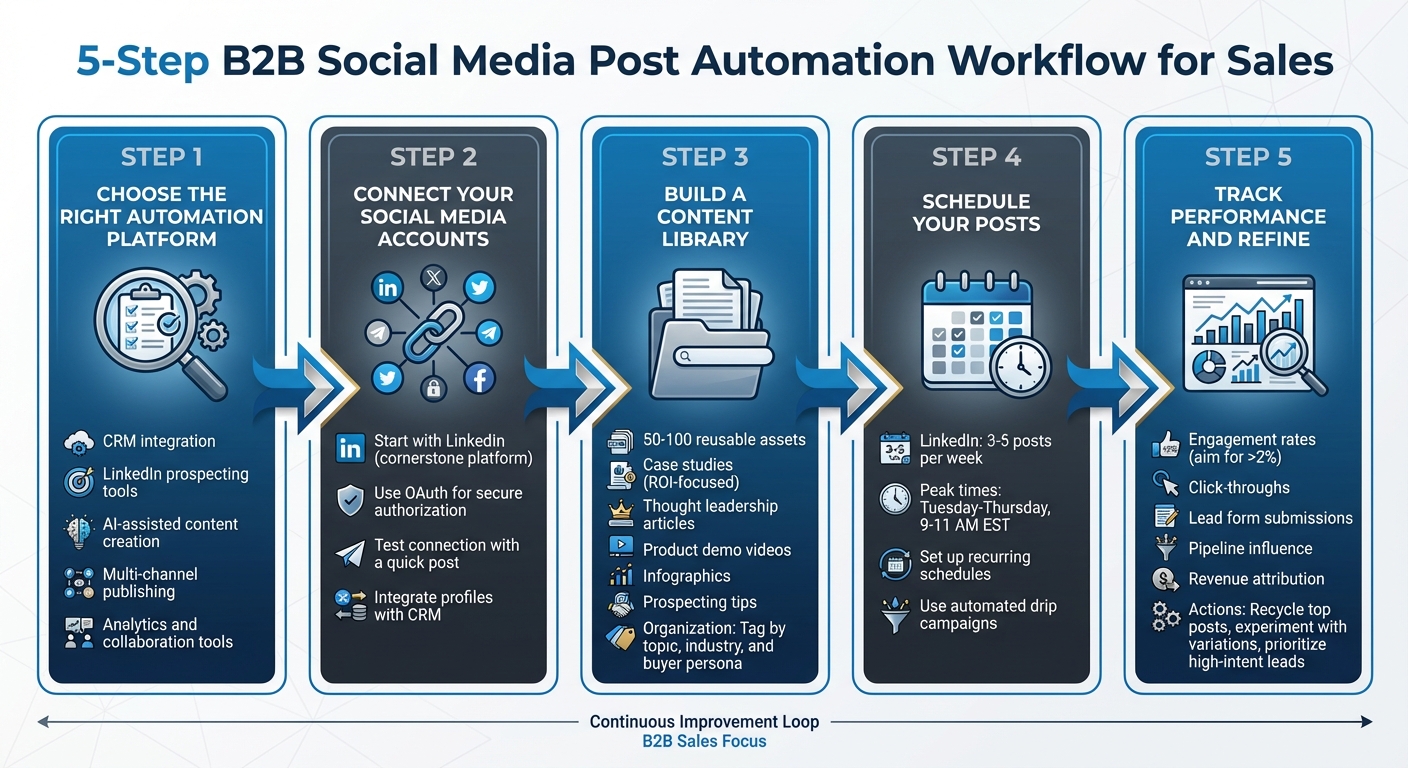
5-Step Process to Automate Social Media Posts for B2B Sales
Why B2B Sales Teams Need Social Media Automation
How Social Media Supports B2B Sales
Platforms like LinkedIn, X (formerly Twitter), and Facebook have become essential tools for B2B sales teams, offering direct access to decision-makers and helping to build a strong sales pipeline. LinkedIn stands out as the go-to platform for connecting with executives through company pages, personal profiles, and direct messaging. It’s a powerhouse for prospecting and social selling. On the other hand, X allows sales reps to participate in real-time industry conversations, track event hashtags, and engage with prospects or influencers early in the relationship-building process. Meanwhile, Facebook proves effective for reaching niche communities and retargeting website visitors, keeping your brand visible and driving prospects back to webinars or product demos.
Posting consistently on these platforms - whether it’s case studies, customer success stories, or educational content - helps establish credibility. Including links to landing pages or gated resources makes it easy to capture leads directly into your CRM. If your team uses tools like Hatrio Sales, you can even track how social interactions contribute to specific opportunities, helping prioritize follow-ups and measure the impact on your pipeline.
These strategies set the stage for the advantages that social media automation can bring to B2B sales teams.
Key Benefits of Social Media Automation for B2B Sales
Modern B2B sales require speed and efficiency, and automation addresses the challenges of managing social media manually. Long sales cycles often involve multiple stakeholders across various time zones, making it tough to maintain consistent, multi-touch engagement without help. Sales reps can spend hours logging into different platforms, crafting posts, and scheduling them individually - time that could be better spent on calls, demos, or closing deals. Without automation, coordinating posts for product launches, events, or promotions can result in inconsistent or overlapping messaging across the team.
Social media automation simplifies this process. Features like bulk scheduling and content queues ensure a steady online presence, even when reps are tied up in meetings or traveling. This leads to higher engagement and visibility, particularly on platforms like LinkedIn. Many automation tools also allow for audience segmentation based on criteria like industry, role, region, or account lists, making your content more relevant to the right people. Tools for social listening and keyword monitoring further help sales teams identify prospects discussing key topics and engage them with timely responses.
The time saved is significant. Centralized scheduling and reusable templates let your team prepare content in advance, while automated alerts ensure quick responses to mentions and comments. This reduces time spent on administrative tasks, freeing up reps to focus on high-value activities like discovery calls, demos, and negotiations. When paired with tools like Hatrio Sales, these automated social interactions seamlessly integrate into your CRM, ensuring that high-intent leads are followed up with personalized outreach.
How To Automate ALL Your Social Media Content in 1 Hour a Week (Step-by-Step Guide 2025)
How to Automate Social Media Posts for B2B Sales
Automating social media posts doesn't just save time - it ensures your B2B sales team maintains a consistent and professional online presence. By following a clear process and using the right tools, you can streamline your efforts while driving measurable results. Here's how to implement automation effectively, from choosing a platform to tracking performance.
Step 1: Choose the Right Automation Platform
The right platform does more than just schedule posts - it becomes a hub for managing your B2B social media strategy. Look for features like CRM integration, LinkedIn prospecting tools, AI-assisted content creation, and analytics that tie social engagement directly to sales outcomes. Multi-channel publishing is essential, allowing you to manage LinkedIn, X, and other networks from one place. Collaboration tools are also key to keeping your team aligned.
For example, Hatrio Sales offers a comprehensive solution that combines social media automation with a full sales suite. Its CRM integration ensures that social activity directly impacts your sales pipeline, eliminating the need for siloed analytics.
Step 2: Connect Your Social Media Accounts
Once you've chosen your platform, connecting your accounts is simple. In Hatrio Sales, navigate to the integrations or social settings dashboard and link your profiles, starting with LinkedIn, the cornerstone of B2B sales. Use OAuth to securely authorize access by entering your credentials and granting permissions for posting and analytics. Afterward, test the connection with a quick post or sync confirmation.
Hatrio Sales takes this a step further by turning social profiles into qualified leads that seamlessly integrate with your CRM.
Step 3: Build a Content Library
A strong content library is the backbone of your social media strategy. Aim to create 50–100 reusable assets tailored to different stages of the sales funnel. These might include:
- Case studies showcasing ROI
- Thought leadership articles positioning your team as experts
- Product demo videos
- Infographics addressing common challenges
- Personalized tips for prospecting
Organize your library by tagging each piece with relevant topics, industries, and buyer personas. This makes it easy to retrieve the right content for every post. Hatrio Sales simplifies this process further by using lead enrichment tools to gather data on prospects, helping you fine-tune your content to meet their specific needs.
Step 4: Schedule Your Posts
With your content ready, it's time to set a posting schedule. For LinkedIn, aim for 3–5 posts per week during peak engagement times - typically Tuesday through Thursday, between 9:00 and 11:00 AM EST. Upload your content, set recurring schedules, and let the platform handle the rest.
Hatrio Sales streamlines this process with automated drip campaigns and multi-touch workflows. This ensures your content goes live consistently, even when your team is busy in meetings or closing deals.
Step 5: Track Performance and Refine Your Strategy
Monitoring results is crucial to understanding what works. Use Hatrio Sales' analytics dashboard to track metrics like engagement rates (aim for above 2%), click-throughs, lead form submissions, and, most importantly, how your posts influence the sales pipeline. Because the platform syncs with your CRM, you can directly attribute revenue to specific campaigns, moving beyond vanity metrics.
Hatrio Sales also uses automated lead scoring to identify your most engaged prospects, helping you prioritize follow-ups. Use these insights to recycle high-performing posts, experiment with new headlines or visuals, and refine your content strategy for better results.
sbb-itb-b22f30c
Advanced Social Media Automation Techniques for B2B Sales
Once you've got the basics of scheduling and tracking down, it's time to step up your social media automation game. By refining your strategy with tools like AI-driven content creation and employee advocacy programs, you can scale your outreach while keeping the personal touch that makes B2B sales effective. These advanced techniques allow you to target prospects more precisely and expand your reach through your team’s networks.
Use AI for Content Creation and Personalization
AI can take the heavy lifting out of creating personalized content. By analyzing prospect data, industry trends, and past engagement, it generates tailored posts that speak directly to your audience's needs. For example, AI can craft LinkedIn updates that address specific concerns, like security for IT decision-makers or ROI for CFOs, saving you hours of manual work.
Platforms like Hatrio Sales make this process seamless. By integrating with your CRM, the tool pulls in prospect data - such as which emails were opened, which links were clicked, and which posts were engaged with. This allows AI to create messages that feel customized and relevant. The result? Higher response rates compared to generic templates.
To get started, connect Hatrio Sales to your social accounts and CRM. Feed it prospect data, and let the AI draft posts tailored to your audience. You can even refine these drafts with prompts like “focus on SaaS CTOs in the United States” for added precision. Plus, Hatrio Sales’ analytics will show which AI-generated posts perform best, so you can fine-tune your approach over time. Another bonus? AI can repurpose long-form content into bite-sized posts or even different formats, making your content strategy more efficient.
But AI is just one part of the equation. To truly maximize your reach, tap into the power of your team.
Set Up Employee Advocacy Programs
Your employees’ networks are some of the most valuable assets for B2B sales. An employee advocacy program encourages your team to share curated company content on their personal profiles, helping you reach new audiences and build trust. After all, people are more likely to engage with individuals than with corporate accounts.
Automation makes these programs easy to manage. Start by creating a pre-approved content library filled with case studies, product updates, and industry insights. Employees can then share this content with a single click. To keep things simple, send notifications through tools like Slack or Microsoft Teams whenever new content is available, along with suggested captions they can tweak to match their voice.
Hatrio Sales adds another layer of efficiency by tracking which employee shares drive the most engagement and lead to qualified prospects. With its sales automation flows and social proof widgets, you can connect social activity directly to your CRM, so you’ll know exactly which posts contribute to pipeline growth. To keep participation high, consider gamifying the process with leaderboards or recognition programs. For example, reward employees whose posts generate meetings or demos. This approach keeps your team motivated while reducing the need for constant oversight from sales leaders.
Conclusion
Automating your social media posts doesn’t just save time - it can turn your social channels into powerful tools for driving revenue. By following the five-step process outlined here - choosing a platform, linking accounts, building a content library, scheduling posts, and tracking results - you can keep prospects engaged while dedicating more time to closing deals. The next sections dive deeper into actionable steps and advanced strategies to help you get the most out of this approach.
We’ve also explored advanced techniques like AI-driven content personalization and employee advocacy programs. Did you know that content shared by employees generates twice the click-through rates of corporate posts? Or that regular posting on LinkedIn can boost engagement by up to five times? These numbers translate directly into pipeline growth when your automation platform links social interactions to your CRM.
Hatrio Sales simplifies this process by combining CRM integration, LinkedIn prospecting, automated drip campaigns, and sales workflows in one package. Beyond just scheduling posts, it offers tools like lead enrichment from a database of over 1.5 billion contacts and automation flows that connect social engagement to qualified leads. With these features, you can continually refine your social strategy for better results.
If you’re just starting out, focus on LinkedIn and one other channel. Aim to schedule three posts per week for 30 days, then track engagement to see what resonates most with your audience. Even small steps - like batching content creation or reusing top-performing posts - can lead to noticeable improvements in your sales efforts.
It’s worth noting that B2B buyers typically complete 57–70% of their research before reaching out to sales, and much of that happens on social media. By integrating automated tools like Hatrio Sales, your team can stay visible and engaged throughout the buyer’s journey. Connect your accounts, load up your content, and let automation handle the heavy lifting - so you can focus on what you do best: closing deals.
FAQs
How does automating social media posts improve B2B sales results?
Automating social media posts can make a big difference in boosting B2B sales by simplifying how you connect with your audience and keeping interactions consistent. With automation, you can schedule posts ahead of time, follow up with leads when it matters most, and send tailored messages to a large audience efficiently.
This method doesn’t just save time - it ramps up lead generation, improves conversion rates, and speeds up the sales cycle. By handling repetitive tasks automatically, sales teams can spend more time on what truly matters: building meaningful relationships and closing deals, which ultimately helps grow the business.
What are the best tips for scheduling LinkedIn posts to boost B2B engagement?
To get the most out of LinkedIn for B2B engagement, aim to post during high-activity periods - typically Tuesday through Thursday, either between 8–10 AM or 4–6 PM. These time slots often align with when professionals are most active on the platform.
Keep your posting schedule consistent to build trust and familiarity with your audience. Make sure your content speaks directly to their interests and challenges, offering real solutions or insights they value. While scheduling tools can help streamline the process and save time, don’t forget to track engagement metrics. Regularly reviewing these insights will help you fine-tune your timing and messaging for even stronger results.
How does AI help create personalized social media content for B2B sales?
AI plays a powerful role in crafting personalized social media content for B2B sales by analyzing data like user behavior, preferences, and engagement patterns. This enables businesses to create messages, offers, and strategies that feel custom-made for specific prospects or audience segments.
With AI-driven insights, B2B sales teams can deliver content that's not just relevant but also impactful, leading to higher engagement and better response rates. This means your social media messaging can align more closely with the unique needs and interests of your target audience, making your efforts far more effective.